03 / ANALYTICAL MEASUREMENT
ICP-MS & Trace-Metal Analysis
Establishing robust analytical control at trace levels, ensuring that raw instrumental signals accurately reflect physical contamination rather than background artifacts.
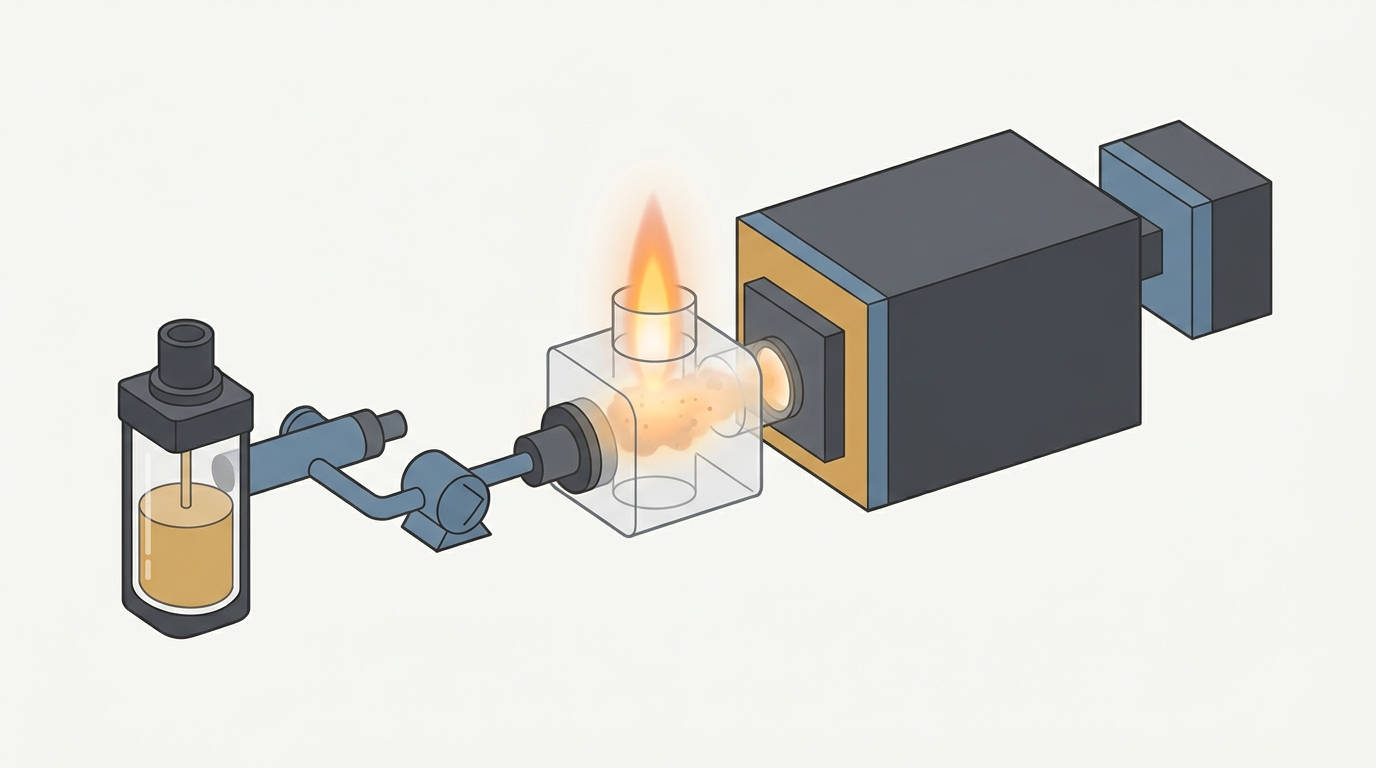
01 Sample & Measurement
The analytical chain begins with rigorous sample collection. Once introduced to the Inductively Coupled Plasma Mass Spectrometer (ICP-MS), the trace metals are ionized and separated by mass-to-charge ratio. The instrument records a raw signal intensity, which is only the starting point of the measurement.
02 Background Correction
At trace concentrations, the blank is often the limiting factor. Isolating the true analytical signal requires rigorous blank subtraction and background correction, distinguishing actual sample contribution from instrumental noise or reagent contamination.
03 Surface Normalization
A mass measurement is meaningless without context. When evaluating wafer or component contamination, the absolute measured mass must be normalized against the specific sampled area, converting raw data into a physical metric (e.g., atoms/cm²) that allows direct comparison across different geometries.
04 Quality Control & Interpretation
Analytical quality control, guided by Statistical Process Control (SPC), ensures measurement stability over time. Validated, normalized data can then be interpreted reliably—whether for trend analysis, isolating contamination sources, or confirming process purity.
Interested in discussing a related research or engineering problem? Start a conversation →