02 / THERMAL PROCESSING
Thermal Oxidation & Furnace Engineering
Experimental process characterization and furnace engineering, focusing on the relationship between thermal fields, process conditions, and resulting film uniformity.
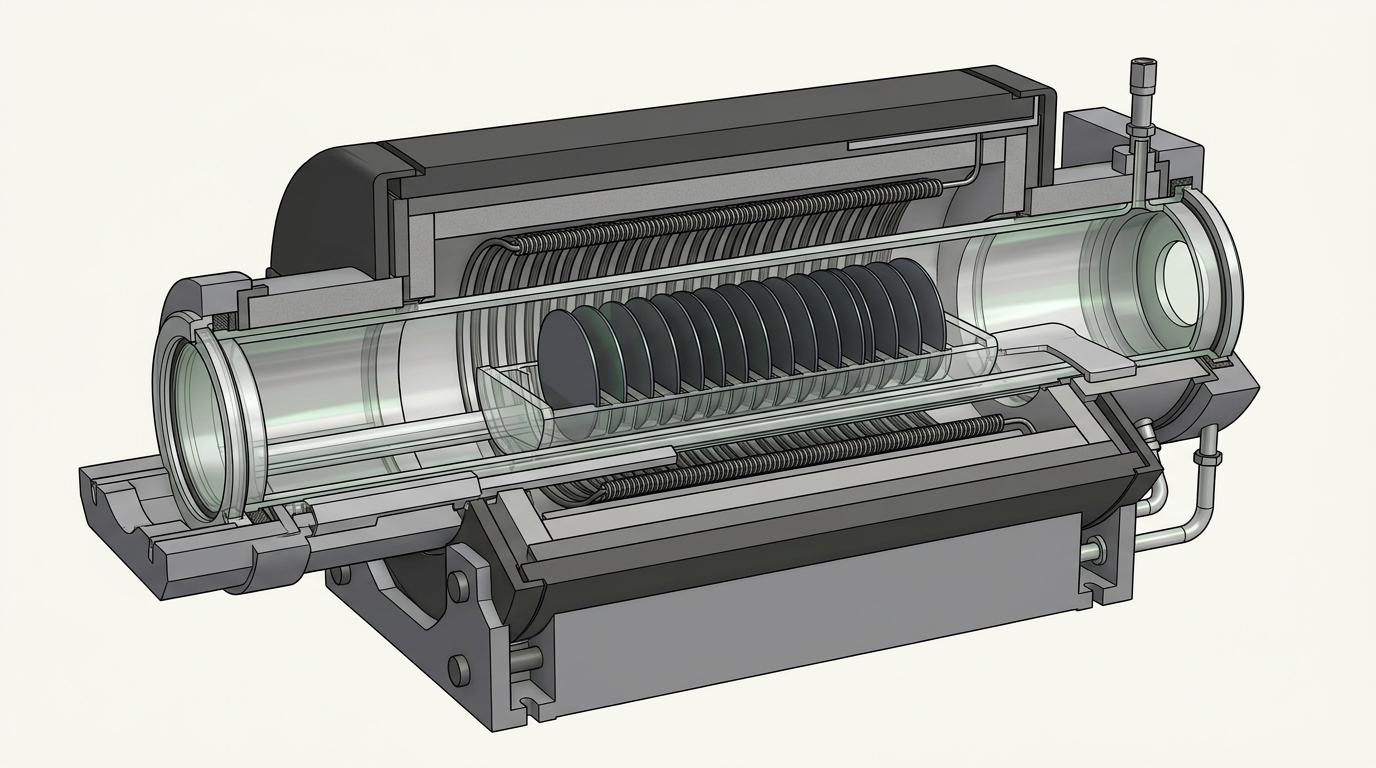
01 Thermal System & Conditions
Characterizing the physical constraints of the furnace. In a horizontal multi-zone furnace, the temperature profile and stable flat-zone establish the baseline environment. Precise process conditions (gas flow, pressure, ramping) dictate how the oxidation proceeds.
02 Oxidation & Growth Model
Observing the Chemical Kinetics The study of reaction rates. In oxidation, it defines how fast the oxide layer grows over time. A mathematical model describing the growth of an oxide layer on the surface of a material, originally developed for silicon.
03 Metrology & Uniformity
Understanding the spatial distribution. How do loading, wafer geometry, and thermal conditions interact to influence across-wafer and wafer-to-wafer uniformity? Oxide-thickness metrology The scientific study of measurement. In semiconductor manufacturing, it refers to precisely measuring film thicknesses, optical properties, and physical dimensions.
04 Diagnosis & Optimization
Closing the loop. Controlled process experiments utilize these measurements to diagnose the root cause of uniformity drift, allowing data-driven optimization of the thermal field or gas delivery system without relying on trial-and-error.
Interested in discussing a related research or engineering problem? Start a conversation →